How to Whisk Matcha the Way Japanese Tea Shops Teach It
Prices checked: November 29, 2026
Ask two of Japan's most respected tea houses how to whisk a bowl of matcha and you get the same skeleton — and different numbers. Ippodo Tea, the Kyoto house founded in 1717, tells you to use 2 grams of matcha, 60 ml of water at exactly 80°C, and to whisk for 15 seconds. Marukyu Koyamaen, the Uji producer whose name is on half the café matcha in the world, says about 1.5 grams, about 70 ml of water, a temperature that changes with the season — and no time limit at all. Neither is wrong. They are two houses teaching two slightly different bowls, and once you see where they agree and where they don't, you can whisk either one with confidence.
The two recipes, side by side
Here is the whole disagreement on one page. Everything below comes from each shop's official preparation guide.
- Matcha: Ippodo 2 g — Marukyu Koyamaen about 1.5 g
- Water: Ippodo 60 ml — Marukyu Koyamaen about 70 ml
- Temperature: Ippodo 80°C, fixed — Marukyu Koyamaen 75–85°C in winter, 70–80°C in summer
- Time: Ippodo 15 seconds — Marukyu Koyamaen not specified; judge by the foam
- Sifting first: both shops, step one
- Motion: both shops, back and forth — never around in circles
The ratio gap is real: Ippodo's bowl works out to roughly 33 grams of matcha per litre of water, Marukyu's to roughly 21. If your home matcha tastes thinner than the bowl you had in Kyoto, this is probably why. But notice what does not differ: sift first, pour, whisk in straight lines rather than circles, and finish by smoothing the surface of the foam. That skeleton is the technique. The numbers are each house's taste.
Step zero: sift — the step both shops put first
Why matcha clumps
Matcha powder clumps on its own. Ippodo's global recipe collection points to static electricity as one cause; Marukyu Koyamaen simply notes that pre-sifted powder dissolves far more easily. Both shops make sifting the literal first step of the method: press the powder through a fine strainer straight into the bowl you will drink from. A lump that survives the sift will survive the whisk, so this is the cheapest quality upgrade in the whole process.
The strainer is the most important tool
When Ippodo's US store ranks the matcha tools, it puts the tea strainer first — ahead of the whisk. The chasen comes second. The chashaku, the little bamboo scoop, is described as not essential. If you are building a kit piece by piece, that is the order the shop itself suggests: strainer, whisk, then the rest.
Usucha, the Ippodo way
Ippodo's basic usucha (thin matcha) recipe: sift 2 g of matcha — one heaped-and-a-half chashaku scoop, or one level teaspoon — into the bowl. Add 60 ml of water at 80°C. Whisk vigorously for 15 seconds. The US recipe describes the motion as an "M" shape: fast, straight strokes, not a stir.
Cooling boiling water without a thermometer
Ippodo's own trick for hitting 80°C: pour freshly boiled water into the empty tea bowl or a cup once. That single transfer knocks the temperature down to about 80°C. No kettle with a dial required.
The 15-second ceiling
Ippodo treats 15 seconds as a limit, not a target. The longer you whisk, the more bitterness comes out, so the shop advises stopping at around 15 seconds regardless of how much foam you have. To finish, slow down and glide the tips of the whisk across the surface of the foam, popping the large bubbles so the surface turns smooth and even. Ippodo is also honest about the foam itself: it mellows the texture and lifts the aroma, but some schools of tea deliberately whisk without foam — the shop states outright that there is no single correct answer.
Usucha, the Marukyu Koyamaen way
Marukyu Koyamaen's guide starts with about 1.5 g of matcha — two chashaku scoops, or a light teaspoon — sifted into a warmed, dry bowl. The water is about 70 ml, and the shop prefers soft water, boiled first and then cooled to temperature.
Winter water vs summer water
Instead of one fixed temperature, Marukyu adjusts by season. In winter, transfer boiling water into a cooling vessel once to land at 75–85°C. In summer, transfer it twice to land at 70–80°C. The logic is built into the method: the bowl and the room steal more heat in January than in July.
No timer: judging by the foam instead
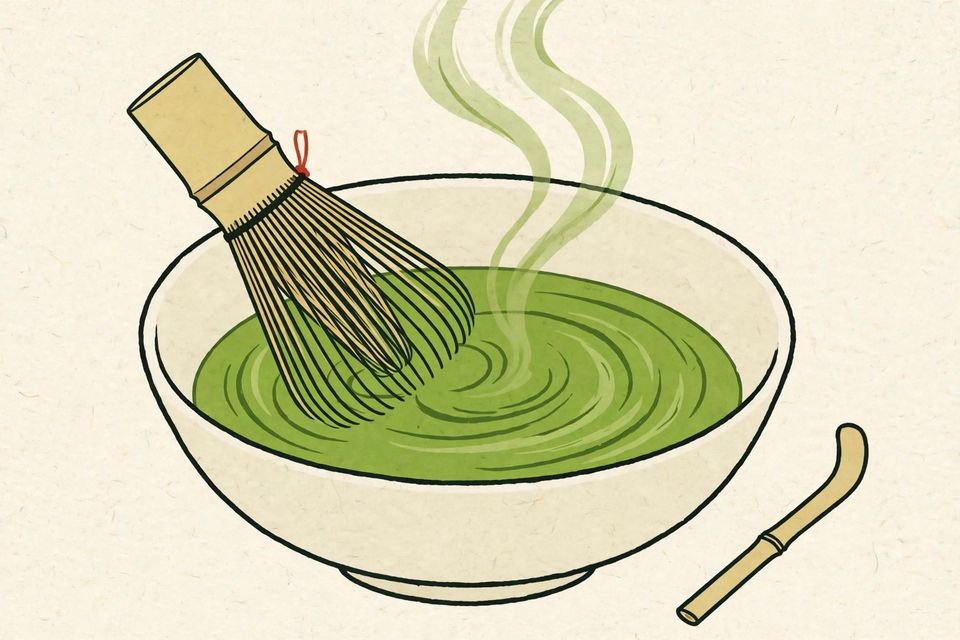
Marukyu's sequence runs on what you see, not what the clock says. First, stir slowly to disperse the powder sitting at the bottom. Then lift the whisk slightly off the base and whisk firmly back and forth with the wrist — carefully, so the water moves in lines and never swirls around the bowl. When a fine, creamy foam has formed, slow down and work the tips across the surface to clear the big bubbles and level the foam. Finally, draw the whisk up slowly from the centre, leaving a small mound of foam in the middle. That mound is the finish line. No seconds are mentioned anywhere in the guide.
Koicha: kneading, not whisking
Koicha — thick matcha — inverts the usucha ratio. Ippodo's recipe uses 4 g of matcha, double the powder, in 30 ml of water at 80°C, half the water. At that concentration you are not whipping anything; Ippodo's own public explanation describes koicha as something you knead rather than foam. (Marukyu Koyamaen's published guide, for reference, does not include a koicha recipe at all.)
The "i" stroke and the 15-vs-30-second question
Here the sources disagree with each other, and we would rather show you that than hide it. Ippodo's official recipe page says to mix slowly for 15 seconds. But in a separate walkthrough given by Ippodo's own PR staff, the same 4 g / 30 ml / 80°C recipe is kneaded for 30 seconds, moving the whisk slowly as if tracing the Japanese hiragana character "い" (i). Same house, same amounts, two times. The safest reading is that the motion matters more than the stopwatch: slow strokes, no foam, a glossy, paint-thick result. If you want a number, both numbers are Ippodo's — pick the one that matches the texture in your bowl.
Sift in small scoops so no lump survives
With 4 g of powder in only 30 ml of water, a lump has nowhere to hide. The PR walkthrough adds a practical tip the recipe page doesn't: sift the matcha in small portions, one or two chashaku scoops at a time, so nothing clumps on the strainer.
Choosing a chasen
100 tips for your first whisk, 80 for experienced hands
Chasen — bamboo whisks — are sold by tine count: 80-tip, 100-tip, 120-tip, and a traditional style called kazuho whose count is not standardised the same way. Ippodo's US store sells two models and states the division plainly: its 100-tip whisk (made in Hangzhou, China) is the one generally recommended for first-time users, while its 80-tip whisk (made in South Korea) is often preferred by experienced matcha makers. The same page adds that both work equally well for everyday matcha. On Ippodo's Japanese store, the difference between its Takayama-made 80-tip and 100-tip whisks is described differently again — as the thickness of the handle, slightly slimmer on the 80. What no official guide claims is a simple ladder where more tines always means better foam. Buy the 100 if you are starting out; that is as far as the shops themselves go.
Takayama, Ikoma: where Japan's whisks come from
The name to know is Takayama — not the city in Gifu, but Takayama-chō, a district of Ikoma City in Nara Prefecture. Takayama chasen have been designated a Traditional Craft Product of Japan since 1975, and according to Nara Prefecture and Ikoma City, the district accounts for over 90% of domestic chasen production. The whisks are carved from a single piece of bamboo, and the work is local enough that "Takayama" on a label functions as an origin mark, not a style name.
Bamboo types: hachiku, kurotake, madake
Nara Prefecture's own materials list the bamboos used for Takayama chasen, including hachiku (henon bamboo), kurotake (black bamboo) and madake (Japanese timber bamboo), harvested in winter, then de-oiled and sun-dried. A Japanese government feature on a Takayama craftsman describes hachiku grown for two to three years, cut in winter, boiled to draw out the oils, then dried and stored for about two years before carving — its straight, supple fibres are what make fine tines possible. The bamboo is on a longer schedule than the tea.
What they cost at official stores
Prices below are from the shops' own stores, checked November 29, 2026. Note that Ippodo runs three stores — Japan, global, and US — and the same whisk can carry a different price in each, so the store is named with every price.
- Ippodo Japan store: Takayama Chasen 100-tip ¥6,930; Takayama Chasen 80-tip ¥6,600 (sold out when checked); Chasen 100-tip (made in China) ¥4,400; whisk stand ¥1,320; matcha starter kit with bowl and whisk ¥9,130.
- Ippodo global store (ships internationally): Takayama Chasen 100-tip ¥6,300; Chasen 100-tip ¥4,000; resin chasen ¥3,500; whisk stand ¥1,200; matcha starter kit ¥8,300.
- Ippodo US store: Chasen #1, the 80-tip whisk, $53; whisk stand $16.
- Marukyu Koyamaen catalogue (October 2024 edition): Japanese-made kazuho chasen ¥4,400; Korean-made kazuho ¥2,860; ceramic whisk stand ¥550. Catalogue prices predate the recent round of tea-price rises, so confirm the current figure in their online shop before relying on it.
Two honest observations. First, a Takayama whisk costs roughly half again as much as an imported one at the same shop — you are paying for the Nara workshop, not for more tines. Second, Ippodo's global store undercuts its own Japan store on the identical Takayama 100-tip (¥6,300 against ¥6,930); if you are ordering from outside Japan, the global store is the one built for you anyway.
The supporting tools
Chashaku: why one scoop is not one scoop
Here is a small scandal hidden in the recipes above. Ippodo's 2 g of usucha matcha equals 1.5 heaped chashaku scoops — so one heaped scoop is about 1.3 g. Marukyu Koyamaen's 1.5 g equals 2 scoops — about 0.75 g per scoop. The same bamboo scoop, measured by two of Japan's best tea houses, differs by more than 70%. A chashaku is a beautiful, traditional measure, but it is not a standardised one: how heaped is "heaped" is doing all the work. Our conclusion, and the one both recipes quietly support by printing gram figures at all, is to weigh your matcha while you learn. A cheap scale gets you either shop's bowl exactly; a scoop gets you somewhere in the neighbourhood.
Bowls: wide and deep beats beautiful
Ippodo's US guide recommends a bowl that is wide and deep — room for the whisk to travel, which makes foam easier to build. Marukyu Koyamaen is more relaxed still: its leaflet allows substitutes such as a soup cup if that is what you have. Given Ippodo's own tool ranking — strainer first, whisk second, scoop optional — a wide bowl you already own is a perfectly legitimate place to start.
The whisk stand is a dryer, not a decoration
The ceramic stand (chasen-tate, sold by Marukyu as a kusenaoshi, a shape-keeper) holds the whisk upright with its tines bellied out to their proper curve. That shape is also how the tines dry. It costs ¥550–¥1,320 at the shops above — the cheapest tool here, and the one that protects the most expensive one.
Chasen care, from the makers
Water only — no detergent, no dishwasher
Ippodo Japan's care notes for its Takayama chasen are unambiguous: no detergent, no dishwasher. Rinse in water immediately after use — the same notes warn that whisking anything other than matcha (milk, for instance) can leave its flavour in the bamboo. Two details new owners often mistake for defects: the curled tips on a new whisk are a protective finish and straighten out once you start using it, and a crack in the handle does not end the whisk's life, because the binding cord holds the piece together.
Never store it damp in its travel case
The clear plastic case a new chasen arrives in is packaging, not storage. Ippodo warns that putting the whisk away in it before it has dried completely invites mould. Let it dry in the open — the stand above exists for exactly this — and treat the case as something to throw away.
When to replace it: read the tips
Ippodo's US FAQ gives a functional test rather than a calendar date: replace the whisk when broken tips become noticeable and it no longer whisks the way it used to. The same source's advice for making it last is technique, not products — whisk gently, and do not grind the tines against the bottom of the bowl (light contact is fine). A chasen is a consumable by design; the makers' guidance is about not consuming it faster than you need to.
The one-page summary
- The skeleton (both shops agree): sift the matcha, add hot water, whisk back and forth — never in circles — then slow down and smooth the surface of the foam.
- The Ippodo bowl: 2 g matcha, 60 ml water at 80°C, 15 seconds, vigorous. Stronger ratio, fixed numbers, beginner-friendly precision.
- The Marukyu Koyamaen bowl: about 1.5 g, about 70 ml, 75–85°C in winter and 70–80°C in summer, no timer — you are done when the foam is fine, creamy and level, with a small mound in the centre.
- Koicha: 4 g in 30 ml at 80°C, kneaded slowly, never foamed. Ippodo's own materials say both 15 and 30 seconds; the motion is the message.
- Tools: strainer first, whisk second. A 100-tip chasen is the shops' recommendation for your first one; a Takayama-made whisk from Ikoma, Nara costs from ¥6,300 at Ippodo's stores. Weigh your matcha — a chashaku scoop is 1.3 g at one great tea house and 0.75 g at another.
- Care: water only, dry it in the open, never seal it damp in its case, and replace it when the tips start to break.
Start with whichever recipe's style suits you — Ippodo's numbers if you like a stronger bowl and a stopwatch, Marukyu's if you would rather learn to read the foam. Then change one variable at a time. That is, as far as we can tell from the people who make the tea, exactly how the shops expect you to learn.
Japan Proven checks prices and claims against Japanese primary sources. When we link to shops, we may earn a commission; our affiliate disclosure explains how this site is funded.
Sources (Japanese primary sources first)
- Ippodo Tea, official global recipes: "Basic Usucha (Matcha)" and "Basic Koicha (Matcha)" — global.ippodo-tea.co.jp (checked November 29, 2026).
- Ippodo Tea US, "Usucha (Classic Matcha)" recipe and "Matcha Whisks, Bowls and Tools" collection page — ippodotea.com (tool rankings, 80-tip vs 100-tip guidance, replacement FAQ).
- Ippodo Tea Japan, Takayama Chasen product pages (80-tip and 100-tip) — ippodo-tea.co.jp (prices, care notes: no detergent or dishwasher, mould warning, tip curl, handle cracks).
- Marukyu Koyamaen, "Preparation of Matcha" — official English site, marukyu-koyamaen.co.jp; official leaflet (Japanese PDF), same domain (usucha amounts, seasonal temperatures, whisking sequence, bowl substitutes).
- Mitsukoshi Isetan FOODIE, "How Ippodo Tea Whisks Matcha" — walkthrough with Ippodo PR staff (koicha kneading, the "i" stroke, 30 seconds, sifting in small scoops).
- Nara Prefecture, "Takayama Chasen" — pref.nara.lg.jp (origin in Takayama-chō, Ikoma City; bamboo types; Traditional Craft designation, 1975).
- Highlighting Japan (Government of Japan public relations), "The Way of the Tea Whisk" (July 2016) — hachiku harvest, de-oiling and two-year drying, via gov-online.go.jp.
- Store prices: Ippodo Japan store, Ippodo global store, Ippodo US store (all checked November 29, 2026); Marukyu Koyamaen official catalogue, October 2024 edition.