Ceremonial vs Culinary Matcha: What Japanese Tea Shops Actually Sell
Prices checked: November 29, 2026
If you shop for matcha outside Japan, the first choice you are offered is a grade: ceremonial or culinary. It sounds official, like a ranking stamped by someone in Kyoto. It is not. No Japanese standard defines it, no Japanese tea shop sells by it, and the international standard does not mention it. Here is what Japan actually uses instead — because once you see the real system, the grade label becomes easy to read for what it is: a seller's nickname, not a certification.
The label that doesn't exist in Japan
Japan's tea industry labeling standard, maintained by the Japan Tea Association (Nihon Cha-gyo Chuo-kai), defines matcha precisely: tencha — shade-grown leaf dried without rolling — ground to a fine powder. Then it stops. The standard sets no grades inside matcha: no ceremonial, no premium, no culinary. What it regulates instead is whether the product is matcha at all. Ground tea made from ordinary leaves is a different product category in Japan, called funmatsucha (powdered tea), and it may not be sold as matcha.
The international picture is the same. ISO/TR 21380:2022, the technical report on matcha developed under Japan's National Agriculture and Food Research Organization (NARO), defines what matcha is and how it is made — and contains no grade tiers. NARO itself notes that the international market has no consensus or rules on matcha grading. The closest thing to "culinary" in the Japanese standard is a note about raw leaf: autumn tencha and coarse leaf are classed as tencha for food processing — a distinction made at the leaf stage, before anyone talks about drinking it.
How a Kyoto tea house actually lays out its shelf
Open Ippodo's matcha shelf and you find eleven blends, every one in the same 20g box, priced from ¥864 to ¥16,200. There are no grade badges. There is a ladder of named blends — Hatsu Mukashi at the bottom, Kanza at the top — and Ippodo explains the ladder in its own words: as the price rises, the blends are designed for richer umami and sweetness; the affordable end is built for a fresher, lighter bitterness. The blend name is the guarantee. Each name is a recipe the house maintains, in some cases a recipe associated with the grand masters of tea schools — a system of endorsement by named taste, not by tier.
Marukyu Koyamaen in Uji lays its catalog out the same way, with one addition that turns out to be the most useful signal in Japanese matcha: the top blends — Tenju (¥21,600 for 20g), down through Kinrin — carry a mark saying they are suitable for both usucha (thin tea) and koicha (thick tea). The lower blends are listed for usucha only. And cooking matcha is not the bottom of the drinking ladder at all: it is a separate category on a separate page, where Wakatake sells at ¥34.6 per gram, below even the cheapest drinking blend.
The real top-shelf test: can it make koicha?
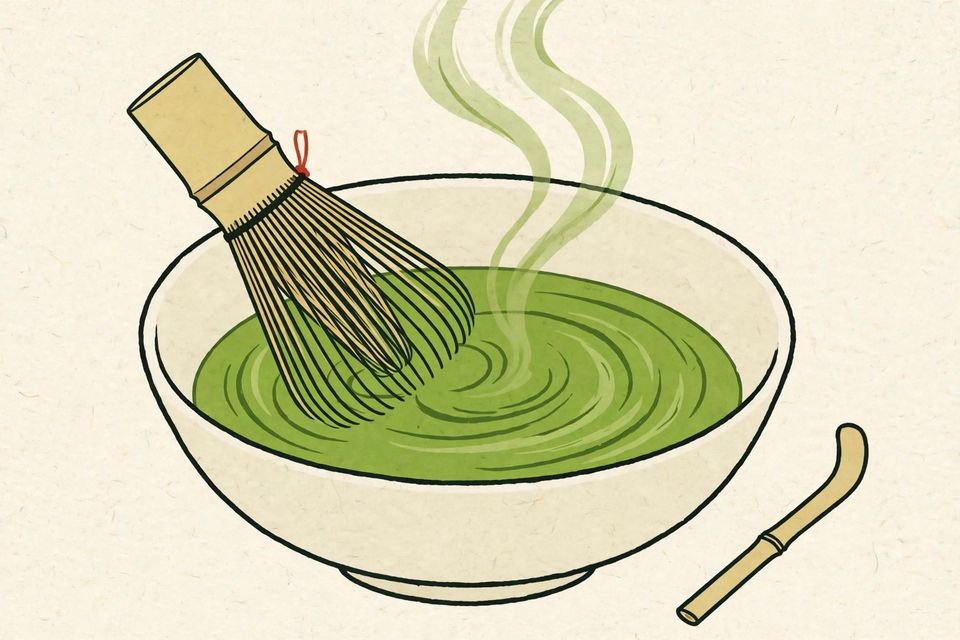
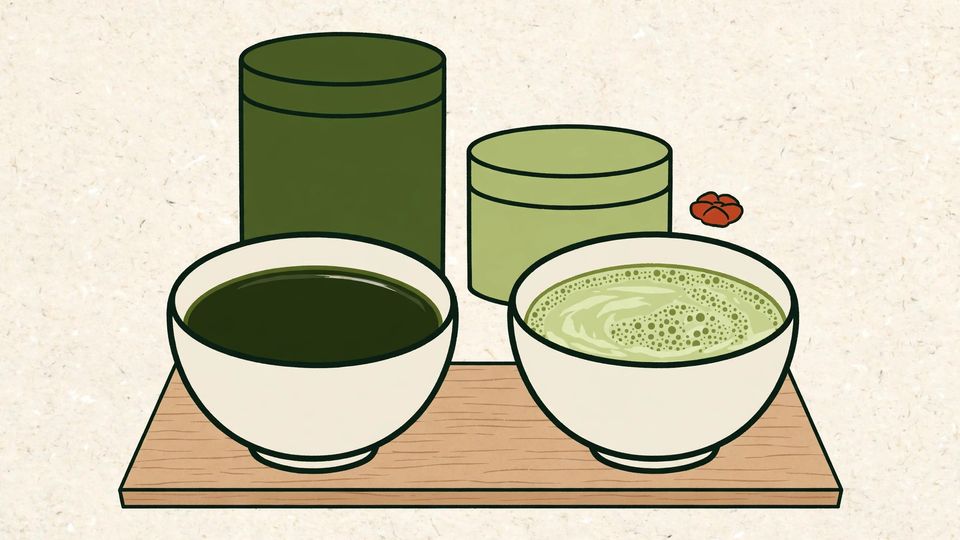
Koicha is where weak matcha has nowhere to hide. By Ippodo's own recipe, usucha uses 2 grams of powder in 60ml of water, whisked to a froth. Koicha uses 4 grams in 30ml — twice the powder, half the water — kneaded rather than whisked, and served at formal tea gatherings. At that concentration, bitterness and astringency dominate unless the leaf itself is rich in umami and low in harshness. That is why Japanese tea houses mark only their top blends as koicha-suitable. "Can it make koicha?" is the closest thing Japan has to a top grade — and unlike "ceremonial," it is printed by the maker, blend by blend, where you can check it.
The ladder has real costs underneath it. In MAFF's reported figures for the 2025 crop, first-flush tencha leaf averaged ¥10,030 per kilogram against ¥4,950 for second-flush — roughly double before anyone has ground a single gram. Harvest timing, which no overseas grade label is required to disclose, is one of the biggest price drivers in the leaf itself.
So where did "ceremonial grade" come from?
From the selling side of the Pacific. The term has no documented first use and no defining body; US tea sellers are candid about this. When Aiya America launched its Ceremonial Grade in 2016 (at $24.80 for 30g), the company itself noted that there is no US government regulation of matcha quality. The word does a job — it tells a first-time buyer "this one is for drinking straight" — but each brand draws the line where it likes. Some shops run two tiers, others three, with a "latte" or "café" grade in the middle. The same word can sit on very different tea, which is exactly the problem Japan's system avoids by refusing to use the word at all.
What to look at instead of the grade
- A maker and a blend name. A real tea house sells named blends it has to keep consistent. An anonymous "ceremonial grade" answers to no one.
- Koicha suitability. If the maker says a blend can be prepared as koicha, that is a checkable claim about the top of their range.
- That it is tencha-based matcha, not powdered tea. In Japan these are legally different products; NARO's analyses can tell them apart by color and umami components. Overseas, the distinction is often left for you to ask about.
- First flush. The leaf costs about twice as much as second flush in Japan's own market data. A seller who discloses harvest timing is showing you a real cost.
- A named origin. Japanese labeling rules tie regional names to actual regional leaf content. Uji, Nishio and Yame on a label are verifiable claims in a way "ceremonial" is not.
- Price per gram, against the Japanese shelf. Drinking matcha at Kyoto and Uji tea houses runs roughly from ¥43 to a few hundred yen per gram, with the top koicha blends reaching ¥750–¥1,080 per gram. A "ceremonial" tin priced far below the bottom of that range is telling you something about its leaf.
- Color and freshness. Vivid green tracks the chlorophyll that distinguishes true matcha in NARO's testing, and Ippodo advises using an opened package within two weeks to a month. Small, recent packages beat big, old ones.
The honest summary
"Ceremonial grade" is not a lie, exactly — it is a translation of a real distinction (tea meant to be drunk straight versus tea meant to be cooked with) into a word that sounds like a rank. Japan makes the same distinction with more precision and less poetry: named blends on a price ladder, a koicha mark for the top of it, and a separate shelf entirely for cooking. Learn to read those three things, and you no longer need the grade — which is fortunate, because nobody is in charge of it.
Japan Proven checks prices and claims against Japanese primary sources. When we link to shops, we may earn a commission; our affiliate disclosure explains how this site is funded.
Sources (Japanese primary sources first)
- Japan Tea Association (Nihon Cha-gyo Chuo-kai), Green Tea Labeling Standard (緑茶の表示基準), Table 1 — definitions of matcha and funmatsucha; note on tencha for food processing.
- National Agriculture and Food Research Organization (NARO), press release on ISO/TR 21380:2022 (April 14, 2022); research on price and chemical composition of Japanese matcha (2018).
- Marukyu Koyamaen, official English catalog (January 2026 edition) — blend ladder, koicha/usucha suitability marks, cooking matcha category and prices.
- Ippodo Tea, official shop prices (October 2026 revision) and blend explanations via Mitsukoshi Isetan FOODIE interview with Ippodo PR — blend ladder ¥864–¥16,200 per 20g; usucha/koicha recipes; freshness guidance.
- Ministry of Agriculture, Forestry and Fisheries figures for 2025 tencha leaf prices (first flush ¥10,030/kg; second flush ¥4,950/kg), as reported from MAFF data.
- Aiya America, press release (January 16, 2016) — Ceremonial Grade launch pricing and statement on US regulation.
- Tezumi and MatchaDB, seller/guide analyses of the term "ceremonial grade" (no documented origin; no defining body).