Japanese Convenience-Store Snacks Worth Shipping Home
Prices checked: November 29, 2026
Every snack in this article costs less than a coffee in Japan. That is exactly the problem. Convenience-store snacks are priced for a person standing in front of a shelf in Tokyo, not for a parcel crossing the Pacific — and the moment you ask someone to buy them, consolidate them and fly them to you, the fees can quietly exceed the snacks. So this guide starts with the math, then the shortlist, then the rules. If you only want the curated version of this experience, our snack-box comparison covers the subscription route; here we are doing it the hands-on way, through Japan's proxy buying services.
First, the honest problem: the snacks are cheap, the shipping is not
A proxy service does not sell you snacks. It sells you a person in Japan: someone who buys what you point at, receives it at a warehouse, packs it into one box and posts it. You pay for the products, a service fee for the buying, domestic postage inside Japan, and international postage on top. The service fee is where the two big proxies differ fundamentally — one charges per item, the other per order — and for a basket of ¥43 chocolates and ¥162 gummies, that difference is the whole story. We will price both below, using only the fees each service publishes.
The shortlist: snacks that survive the trip
The filter here is boring and strict: sold nationwide in Japan according to the manufacturer, dry or shelf-stable, and with a best-before period measured in months, not days. Everything below is confirmed as a current product on the maker's own announcements.
Jagarico (Calbee)
The crunchy potato sticks in a cup are a Calbee staple — Salad, Cheese, Jaga Butter and Tarako Butter are sold nationwide, and Calbee keeps launching convenience-store-first spin-offs (a recent one, Jagarico Salad Bits, went on sale at convenience stores across Japan before anywhere else). Calbee sells Jagarico at open pricing, meaning there is no official retail price — the shelf price varies by store, so be suspicious of any overseas listing that presents one number as "the" price. The cup packaging is the real reason it is on this list: it protects the sticks in a way a crinkly bag never will.
Pure Gummy (Kanro)
Kanro's Pure Gummy is the rare snack with an honest official price: the three standard flavors — Lemon, Grape and Muscat, 56g each — carry a reference price of ¥162 including tax, and the Premium line is ¥194. New Premium flavors launch first at convenience stores and station kiosks in Japan, which is why the flavor you saw on social media may not exist in your country's imports yet. Gummies are light, small and close to indestructible in a parcel: the ideal filler around everything else.
Black Thunder (Yuraku Seika)
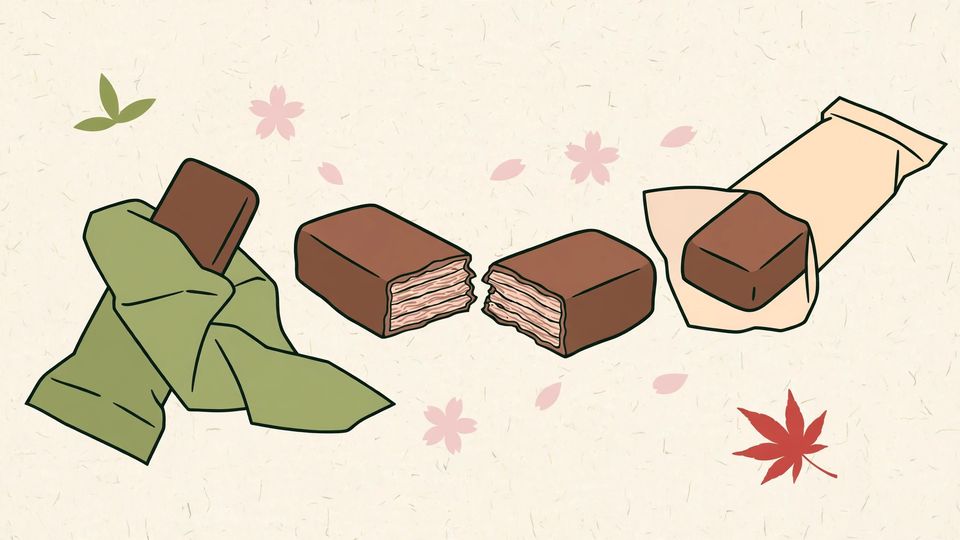
Japan's most famous cheap chocolate bar has an official reference price of ¥43 including tax for a single bar — less than the postage stamp on the parcel it would travel in. Yuraku sells it nationwide at convenience stores, supermarkets and drugstores, and the convenience chains get their own exclusives: Lawson, for example, has carried a Lawson-only strawberry-and-butter bite-size version at a standard price of ¥200. The bar itself is cocoa cookie and chocolate, built to be eaten in four bites, and it travels well outside the summer months.
Country Ma'am Choco Mamire (Fujiya)
Fujiya's Choco Mamire — a Country Ma'am cookie drowned in chocolate — has become a series in its own right, including winter-limited editions sold nationwide; the current winter version went on sale across Japan on November 17, 2026, with one size sold only through limited channels including convenience stores. Fujiya prices it open, so again, treat any single "official price" you see abroad with caution. This is the snack to time an order around: it exists because it is cold outside.
Winter-only chocolate (the Meltykiss season)
Every winter, Meiji releases limited chocolates under its Meltykiss banner — this season's almond and macadamia versions go on sale nationwide on December 1, 2026, for a limited period, at open pricing. The general point matters more than the specific product: Japan's best chocolate snacks are seasonal, and the season is winter. Chocolate shipped through summer heat can arrive bloomed or melted, so the calendar is part of the shipping strategy. Buy chocolate when Japan is cold, and let it travel while your hemisphere is cold too.
The expiry-date math
Japanese packs carry one of two dates, and the difference decides what you may ship. A shōhi kigen is a use-by date, found on foods that spoil quickly. A shōmi kigen is a best-before date: Japan's ministries define it as the period during which the food, stored as directed, can be expected to keep all of its intended quality — and note that passing it does not instantly make the food inedible. Snacks are the textbook example of best-before products, and foods with a shelf life over three months are even allowed to print only the year and month. In practice, many dry snacks, gummies and chocolates of the kind above carry best-before periods on the order of five to six months. Against a realistic two to four weeks of proxy handling, warehouse time and international transit, that is comfortable. The line to draw: if it has a use-by date, needs a fridge, or contains fresh cream, it does not go in the box.
Route 1: ZenMarket, priced per item
ZenMarket's service fee is charged per item: ¥300 per item at its recommended stores, ¥500 at most stores including Amazon Japan and Rakuten, and ¥800 for Mercari and auction purchases. Multiple units of the same product count as one item; a different color or size counts as a new one. The fee bundles the buying itself, the first consolidation of your items into one parcel, shipping insurance on parcels under ¥5 million, and Japanese bank fees. On top of that you always pay the product prices, a deposit fee of 1% or more depending on payment method, and international postage; domestic postage inside Japan is added when the seller charges it.
Storage is generous, with a hard edge: 60 days free in the warehouse, then ¥50 per item per day, and a maximum of 90 days in total — items left past that are disposed of without compensation. International postage is not a fixed table. ZenMarket calculates it by method, weight, size and destination after your items are packed and weighed, and offers a calculator for estimates before that point. Carriers range from postal services (EMS, airmail, surface) to couriers such as FedEx, UPS and DHL, and any customs duties or taxes are the destination country's business, collected on their terms.
Route 2: Buyee, priced per order
Buyee charges ¥500 per order, not per item, plus a plan fee of ¥0 to ¥500 per order depending on the protection you pick — the Lite plan adds nothing, inspection adds ¥300, and the standard and insured-delivery plans add ¥500. Payment comes in two rounds: first the products, purchase fee and plan fee; then, once everything reaches the warehouse, domestic postage, international postage, options and any tax-related charges. Domestic postage is charged at cost — Buyee's own guide gives a typical range of ¥150 to ¥1,500. International postage is likewise charged at cost, measured from the actual weight and size of your parcel at the warehouse; Buyee states plainly that its advance estimator is a guide, not a guarantee.
Storage is shorter than ZenMarket's: the first 30 days after arrival are free, extension fees apply after that, and the maximum is 90 days — Buyee reserves the right to dispose of items whose shipping is not paid for within that window.
So which one is cheaper for snacks?
It depends entirely on the shape of your basket, and anyone who gives you a single answer has not done the arithmetic. ZenMarket's per-item fee punishes variety: ten different snacks bought through a standard store cost 10 × ¥500 = ¥5,000 in service fees alone, before a single product is paid for. The same ten snacks in one Buyee order cost ¥500, plus ¥0–500 of plan fee. Run the basket the other way — a couple of items each from many different shops — and the picture flips: every shop is a separate order at Buyee, while ZenMarket's per-item fee does not care which shop an item came from. For cheap snacks, the rule of thumb writes itself: many kinds from one store favors per-order pricing; a few items scattered across many stores favors per-item pricing. In both cases, remember that product prices and the final, weighed postage sit on top of these fees — the service fee is the part you can know in advance, and for snacks it is often the bigger half of the bill.
The rules nobody puts on the product page
Food is regulated cargo, and the United States — the destination most readers will ship to — is a good example of how the system actually works. The US Food and Drug Administration requires prior notice before food is imported, and requires the facilities that manufacture, process, pack or hold food to be registered with it. Imported food can be examined at the border, and it must meet the same legal requirements as food made in the US, including sanitary production and accurate labeling in English. Here is the part that corrects a thousand product listings: the FDA states explicitly that it does not approve or certify individual importers, products, labels or shipments in advance. There is no such thing as an "FDA-approved" Japanese snack; the phrase is marketing, not a status.
What does this mean for a personal parcel of packaged snacks? It means the system is built around declarations and checks, not pre-clearance — and it means the practical gatekeeper is your proxy service's own prohibited-items list and your destination's customs rules. Ingredients are where parcels get stopped: snacks containing meat, and in some destinations egg or dairy components, can be refused even when the same brand's plain chocolate sails through. Neither we nor anyone else can honestly tell you a given snack is "always fine" for every country. Before you pay for a basket, check the service's restricted-items page for food, and your own customs authority's guidance for food by post. That five-minute check is the difference between a snack haul and a confiscation notice.
The bottom line
Shipping convenience-store snacks home is worth it when the snacks themselves are the point — the flavor that never gets exported, the winter chocolate that exists for three months, the ¥43 bar you cannot buy at any price locally — and when you consolidate enough of them into one parcel that the fixed fees spread thin. It is not worth it for a single bar, and it is never worth guessing: pick snacks with months of best-before life, decide whether your basket is a one-store haul or a many-store scatter before choosing between per-order and per-item pricing, and accept that the final postage number only exists after a warehouse scale has the last word. Cheap snacks, honestly shipped, are still cheap. They are just not ¥43 anymore.
Japan Proven checks prices and claims against Japanese primary sources. When we link to shops, we may earn a commission; our affiliate disclosure explains how this site is funded.
Sources (Japanese primary sources first)
- Calbee, "Notice of Price Revisions and Content Changes" (May 14, 2026) — Jagarico staple flavors sold nationwide; open pricing. Jagarico Salad Bits release announcement (2025) — convenience-store-first launch, expected price around ¥140.
- Kanro, press release (February 26, 2026) — Pure Gummy standard flavors ¥162 (tax incl.), Premium ¥194 (tax incl.); Premium flavors launch first at convenience stores and station kiosks.
- Yuraku Seika, press release (2026) — Black Thunder single bar reference price ¥43 (tax incl.), sold at convenience stores, supermarkets and drugstores nationwide.
- Lawson, official site — Lawson-only Black Thunder bite-size strawberry & butter, standard price ¥200 (tax incl.).
- Fujiya, press releases — Country Ma'am Choco Mamire winter-limited edition on sale nationwide November 17, 2026, one size limited to selected channels including convenience stores; open pricing.
- Meiji, press release (2026) — Meltykiss-style winter chocolates on sale nationwide from December 1, 2026, limited period; open pricing.
- Ministry of Health, Labour and Welfare / Ministry of Agriculture, Forestry and Fisheries, "Common Q&A on Processed Food Labeling" — definitions of use-by and best-before dates; year-and-month labeling permitted for shelf lives over three months.
- ZenMarket, official Fees page and Shipping page — per-item service fees ¥300–¥800, included services, 60 days free storage (90 days maximum), international postage calculated after packing and weighing.
- Buyee, official FAQ and fee guide — purchase fee ¥500 per order, plan fees ¥0–¥500 per order, two-stage payment, 30 days free storage (90 days maximum), international postage measured at the warehouse; estimator described as a guide only.
- US Food and Drug Administration, "Importing Food Products into the United States" and "Prior Notice of Imported Foods" — prior notice and facility registration requirements; FDA does not approve or certify individual products or shipments in advance.